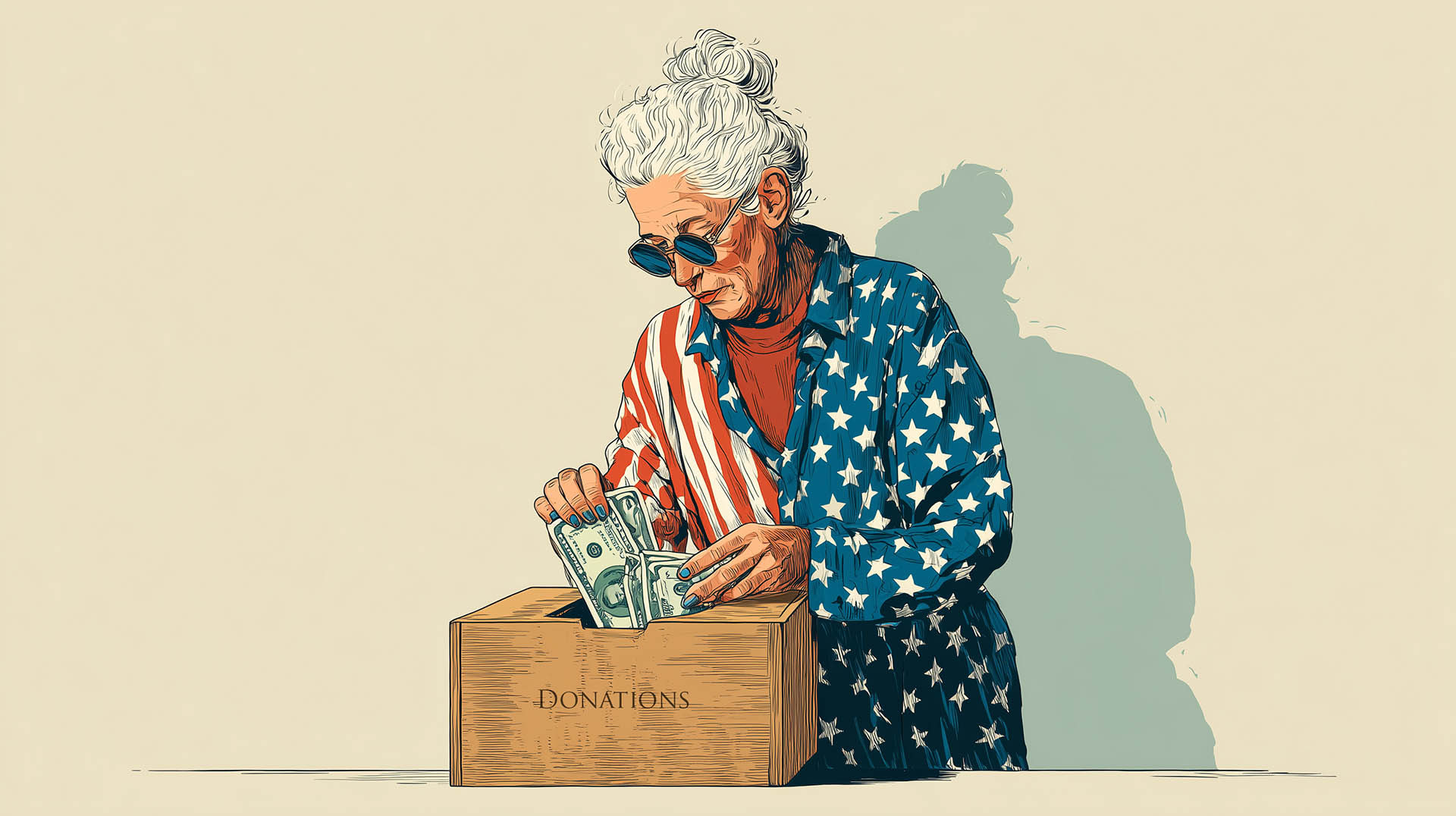
Show Me the Money: Where Campaign Cash Goes When the Race Ends

By Kendall Coughlin,
The Gavel, Editor-in-Chief
J.D. Candidate, Class of 2025
When Vice President Kamala Harris raised over $1 billion in just three months for her 2024 presidential campaign, it begged the question: what happens to all that cash when the confetti settles and the race is over?1 For most candidates, Election Day is not just the end of their political aspirations—it is also the beginning of a complex financial unwinding process that, although is about as exciting as watching paint dry, is also incredibly consequential.
In the high-stakes poker game of American politics, the house always wins—but the losers don’t get to take their chips home. Instead, they enter a labyrinth of regulations that would make even the most zealous accountant reach for an aspirin. The cornerstone of campaign finance law is crystal clear: no matter how much money you raise, you can’t use it to buy that vacation home you’ve been eyeing. The Federal Election Commission (“FEC”) prohibits candidates from converting campaign funds to personal use—a rule that has remained consistent even as other campaign finance regulations have evolved over time.2
Not surprisingly, the biggest rule for these funds is “no personal use.”3 However, this was not always the case. Before 1989, retiring federal lawmakers could pocket extra cash for whatever personal luxuries they desired, from new cars to pet grooming services.4 The Ethics Reform Act slammed that particular piggy bank shut.5 Now, candidates who find themselves with a cash surplus after the ballots are counted have several legal options: pay off any campaign debts and expenses6 (a priority for most), return contributions to donors7 (rarely the first choice), donate to charitable organizations8 (popular with retiring politicians), transfer funds to political party committees9 (no limits here!), contribute to other candidates10 (up to $2,000 per election), convert the campaign committee to a Political Action Committee,11 or keep those dreams alive and save the funds for a future campaign.12
The timing of a campaign’s end matters tremendously. When a candidate drops out mid-race—say, after losing a primary but before the general election—additional rules kick in. Contributions specifically designated for the general election must be refunded to donors within sixty days of dropping out if the candidate doesn’t advance.13 Alternatively, with contributor permission, these funds can be redesignated for other purposes—a bureaucratic dance that campaigns would rather avoid.14 As Robert Kelner noted, an election law specialist at Covington & Burling, campaigns ideally spend money as it comes in to maximize winning chances, not stockpile it for a rainy post-election day.15
Super PACs play by slightly different rules. These political committees, which can raise unlimited sums but cannot coordinate directly with candidates, typically return leftover funds to donors after covering their wind-down costs.16 Nothing illustrates these rules better than seeing how past campaigns have navigated the aftermath of electoral defeat. Former Senator Joseph Lieberman demonstrated perhaps the most altruistic approach, transferring funds from his Senate campaign to establish a college scholarship fund for Connecticut high school students.17 He also used some of the funds in his political war chest to organize his papers for donation to the Library of Congress—creating a legacy beyond his legislative work.18
The 2020 election cycle saw Mike Bloomberg make headlines by funneling a whopping $18 million from his short-lived presidential campaign into the Democratic National Committee after dropping out, amounting to quite the parting gift.19 After losing his 2020 bid for Oregon’s Fourth Congressional District, Republican Alek Skarlatos took a different approach, using $93,000 in leftover campaign cash to seed a nonprofit veterans’ group.20
But not all campaigns end with a surplus. The 2024 Harris presidential campaign reportedly finished $20 million in debt despite raising over $1 billion.21 This echoes challenges faced by 2012 Republican primary candidates Newt Gingrich and Rick Santorum, who spent months post-campaign fundraising just to pay off their debts.22 Former presidential hopefuls Rudy Giuliani, Dennis Kucinich, and John Edwards took years to clear their campaign obligations.23
While federal regulations apply to presidential and congressional campaigns, those running for state and local offices face a different landscape—one that varies dramatically depending on geography.24 For example, Georgia’s rules offer more flexibility than federal regulations, allowing leftover funds to be transferred to another campaign, saved for future campaigns, or donated to political parties and charities, all without the strictures of federal contribution limits.25 Also, Oregon permits the use of campaign funds for “any lawful purpose” other than personal use—a broad standard that gives candidates considerable leeway.26 Retiring lawmakers in Oregon might even use campaign funds to help spouses relocate to be near the state capital—something federal rules would scrutinize.27
Enforcement of these regulations also varies widely. The FEC has been described as “an agency that was designed to fail because it requires bipartisan cooperation”—a commodity in short supply these days.28 State oversight runs the gamut from robust to practically nonexistent.29
Following the money trail of defunct campaigns reveals more than just accounting practices—it offers insights into candidates’ future intentions. Those who donate funds to their party or transfer them to other candidates often plan to remain politically active.30 Conversely, politicians who direct surplus funds to charity are typically signaling their exit from public life.31
The rules governing campaign leftovers reflect our democratic values: transparency, accountability, and the principle that politics shouldn’t be a path to personal enrichment. But the complex, sometimes contradictory, regulations also mirror our imperfect system. So next time you see a campaign commercial and wonder where your contribution might end up if your candidate doesn’t win, remember: what happens in politics doesn’t always stay in politics—but the money usually does. 10 | avemarialaw.edu
References:
1 Harris campaign hits $1bn in fundraising: Reports, Al Jazeera (Oct. 9, 2024), https://www.aljazeera.com/news/2024/10/9/harris-campaign-hits-1bn-in-fundraising-reports.
2 Ethan Trex, What Happens to Leftover Campaign Funds When a Candidate Drops Out?, Mental Floss (Feb. 12, 2020), https://www.mentalfloss.com/article/29636/what-happens-leftover-campaign-funds-when-candidate-drops-out.
3 Jess Henig, Leftover Campaign Funds, FactCheck.org, https://www.factcheck.org/2008/02/leftover-campaign-funds/ (last visited Feb. 10, 2025).
4 Id.
5 See Ethics Reform Act of 1989, Pub. L. No. 101-194, 103 Stat. 1716 (1989).
6 Winding Down Costs, Fed. Election Comm’n, https://www.fec.gov/help-candidates-and-committees/winding-down-candidate-campaign/winding-down-costs/ (last visited Feb. 10, 2025).
7 Deborah D’Souza, What Happens to Campaign Contributions After Elections?, Investopedia (Sept. 23, 2024) https://www.investopedia.com/articles/markets/042716/what-happens-campaign-funds-after-elections.asp.
8 Emery Winter & Casey Decker, No, presidential candidates can’t do whatever they want with leftover campaign funds, Verify (Jan. 24, 2024) https://www.verifythis.com/article/news/verify/elections-verify/leftover-campaign-funds-presidential-election-primaries-desantis-haley/536-51543d44-a175-4203-a489-c87689986e75.
9 Hennig, supra note 3.
10 Id.
11 See Winter, supra note 8.
12 See D’Souza, supra note 7.
13 Id.
14 Id.
15 Id.
16 See Trex, supra note 2.
17 Richard Briffault, When presidential campaigns end, what happens to the leftover money?, The Conversation (Feb. 12, 2020), https://theconversation.com/when-presidential-campaigns-end-what-happens-to-the-leftover-money-130042.
18 Id.
19 Megan Lebowitz, Here’s what happens to candidates’ leftover money, NBC News (Nov. 16, 2022), https://www.nbcnews.com/meet-the-press/meetthepressblog/s-happens-candidates-leftover-money-rcna57340.
20 Pat Dooris & Jamie Parfitt, What do candidates do with campaign funds after the election is over?, KGW8, (Nov. 10, 2022), https://www.kgw.com/article/news/local/the-story/campaign-funds-cash-spending-after-election-day/283-8f61ea0d-5897-4ba7-bc3b-7010504f27d3.
21 Dwayne Oxford, How did Kamala Harris’s campaign rack up a debt after record fundraising?, Al Jazeera (Nov. 14, 2024), https://www.aljazeera.com/news/2024/11/14/how-did-kamala-harriss-campaign-rack-up-a-debt-after-record-fundraising.
22 See Briffault, supra note 17.
23 Id.
24 Federal campaign finance laws and regulations, Ballotpedia, https://ballotpedia.org/Federal_campaign_finance_laws_and_regulations (last visited Jan. 28, 2025).
25 Chris Grant, Campaign Finance Laws, New Georgia Encyclopedia, (Feb. 20, 2013), https://www.georgiaencyclopedia.org/articles/government-politics/campaign-finance-laws/.
26 See Dooris, supra note 20.
27 Id.
28 See Lebowitz, supra note 19.
29 See Campaign Finance Regulation: State Comparisons, Nat’l Conf. of State Legislators (Oct. 24, 2022), https://www.ncsl.org/elections-and-campaigns/campaign-finance-regulation-state-comparisons.
30 See Lebowitz, supra note 19.
31 Id.