At Warsaw’s Biennial Conference, Scholars Examine Truth, Law, and Artificial Intelligence
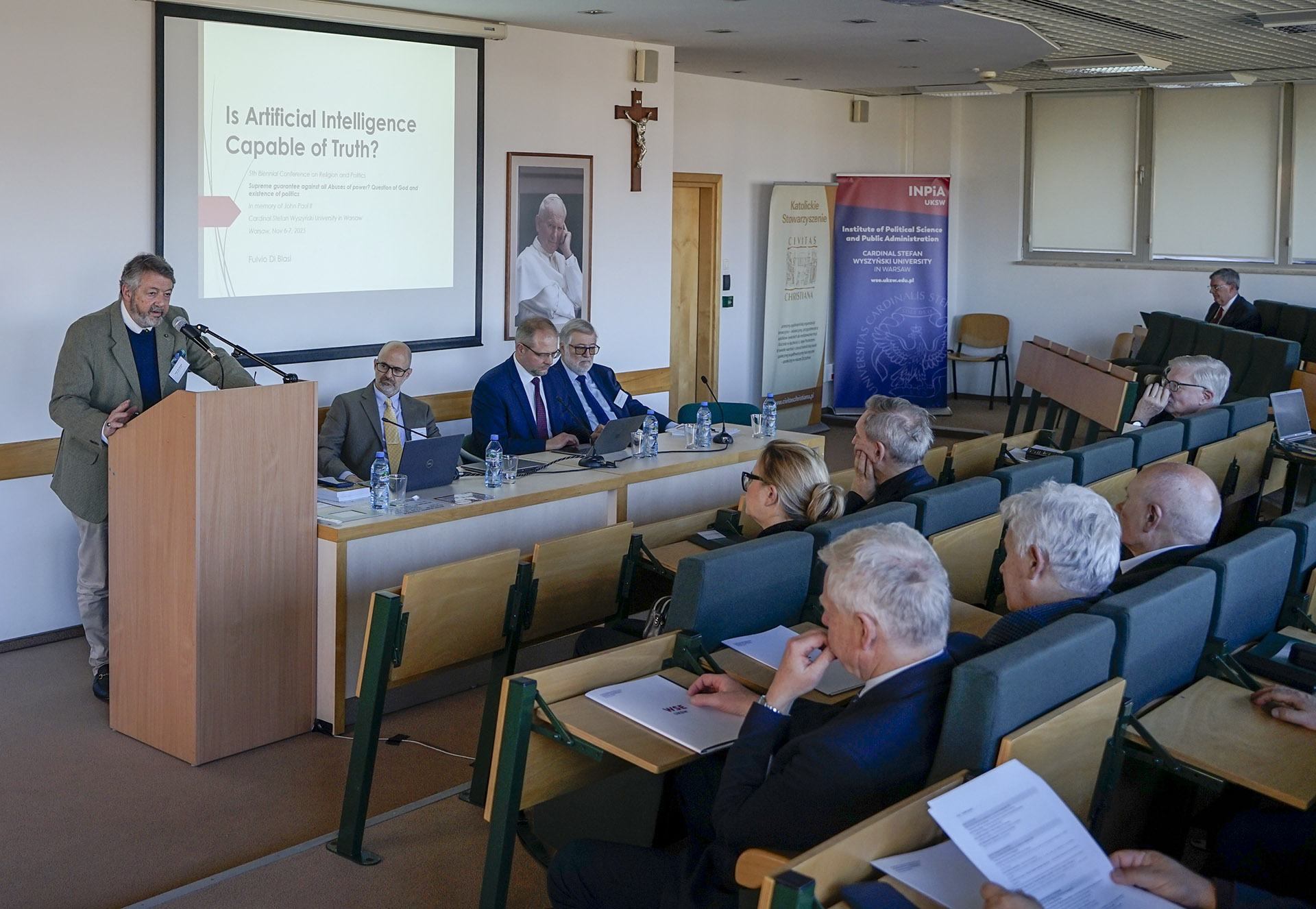
Warsaw, Poland — At the 5th Biennial Conference on Religion and Politics, hosted by the Institute of Political Science and Public Administration at Cardinal Stefan Wyszyński University, international scholars gathered to examine whether the teachings of St. John Paul II still speak to the modern world.
The two-day event marked the 20th anniversary of the late pontiff’s death and reflected on the enduring relevance of his social and political thought. Ave Maria School of Law was represented by Dean John M. Czarnetzky, Professor Ligia Castaldi, and Professor Brian Scarnecchia.
One of the conference’s most thought-provoking sessions, titled “On Truth,” addressed the intersection of faith, reason, and artificial intelligence, asking whether modern technology can ever truly comprehend or convey truth.
Moderated by Professor Ian Benson of the University of Notre Dame (Sydney), the panel featured Professor Fulvio di Blasi of the Thomas International Center for Philosophical Studies, Professor Jacek Koronacki of the Polish Academy of Sciences, and Professor Aleksander Stępkowski of the University of Warsaw.
Setting the Stage
Professor Benson opened the session by thanking Ave Maria School of Law for co-sponsoring both the Warsaw conference and a recent Washington, D.C., event on Truth, Freedom, and Expression in an Age of Censorship.
Drawing upon his background in legal philosophy, Benson reflected on the modern tension between technique and teleology—between how things are done and why they are done. “If law is only taught as hows,” he cautioned, “we never get to justice.”
He described the principle of subsidiarity as vital to human freedom, contrasting it with the dangers of top-down governance. With that foundation, the panel turned to examine how truth, freedom, and technology intersect in an increasingly mechanized age.
Professor Fulvio di Blasi: “Is Artificial Intelligence Capable of Truth?”
Professor di Blasi, an Italian philosopher of law, argued that truth cannot exist apart from the spiritual and moral dimension of the human person.
Using a vivid thought experiment, he compared AI to a waterfall that, by coincidence or programming, produces words on a rock. Would anyone debate the truth of those words with the waterfall? Of course not—and yet, he suggested, society treats AI as if its calculations were acts of intellect and will.
Citing St. Thomas Aquinas, di Blasi explained that truth requires self-awareness and freedom, capacities absent in machines. “Knowledge,” he said, “is not the mechanical possession of information but a judgment born of intellect.”
In his view, artificial intelligence cannot know anything—it only reflects patterns predetermined by human input.
For the field of law, he warned, this means that no algorithm, however advanced, can render a moral or legal judgment. Justice demands intellect, not computation.
Professor Jacek Koronacki: “Artificial Intelligence and Truth About Us in a Time of Confusion”
A statistician and computer scientist by training, Professor Koronacki affirmed di Blasi’s position from a technical standpoint. While acknowledging AI’s extraordinary capabilities—from chess mastery to molecular modeling—he drew a firm distinction between calculation and comprehension.
“AI rests entirely on probability and engineering,” he said. “It can talk with us and even seem empathetic, but it does not understand anything.”
Koronacki emphasized that language models process syntax, not semantics. Their outputs are products of probability, not meaning or intent. Quoting writers such as Henry Kissinger and Yuval Noah Harari, he warned against a growing cultural temptation to attribute consciousness to machines.
Even if future computers could simulate biological or sensory processes, he argued, they could never reach the rational, immaterial intellect that defines the human person.
“Only man,” he concluded, “can move from knowledge of particulars to knowledge of universals—to truth itself.”
Professor Aleksander Stępkowski: “Why Has the Truth Become Uncorrect?”
Professor Stępkowski, a judge of the Supreme Court of Poland and chair of sociology of law at the University of Warsaw, addressed the crisis of truth in contemporary legal culture.
Drawing on thinkers such as Thomas Hobbes and Joseph Ratzinger, he observed that modern societies increasingly ground the legitimacy of law not in moral truth but in political power. When truth is dismissed as divisive or “dangerous,” he warned, law degenerates into force without logos.
He traced this development to a philosophical rupture between what is and what ought to be, noting that as societies abandon shared moral foundations, the line between law and lawlessness blurs. For Stępkowski, the solution lies in recovering confidence that truth—especially moral and natural law truth—is essential to justice and social peace.
A Shared Warning
Together, the panelists offered a strikingly unified message:
Artificial intelligence, however advanced, remains a tool, not a bearer of truth. Law, justice, and the human intellect depend on something more profound—the freedom to judge, to discern, and to seek the good.
As the conversation moved from philosophy to law, one conclusion became clear:
In an age when algorithms can replicate speech and pattern, the greater challenge is not whether AI can know truth, but whether humanity still desires it.
Watch live: Cardinal Stefan Wyszyński University YouTube Channel
View the full conference agenda: Download the program (PDF)
Conference Continues
The 5th Biennial Conference on Religion and Politics: “Supreme Guarantee Against All Abuses of Power? Question of God and Existence of Politics” continues today and tomorrow at Cardinal Stefan Wyszyński University in Warsaw. Held in memory of St. John Paul II, the event brings together leading scholars from around the world to explore the moral and theological foundations of public life.
Ave Maria School of Law is represented among the distinguished participants, including:
-
Prof. Ligia Castaldi, presenting “Constitutional right to abortion in communist/ post-communist countries: an international comparative law perspective.”
-
Prof. Brian Scarnecchia, presenting “Human Enhancement Regulated by John Paul II’s Understanding of Human Ecology.”
-
Dean John M. Czarnetzky, delivering the conference summary alongside Prof. Michał Gierycz, chair of the organizing committee.