Paths to Presidency and Papacy:
Comparing the Electoral College and the College of Cardinals

By Victoria Porter,
Moot Court Board
J.D. Candidate, Class of 2025
Author’s note: As this article was going to publication, Pope Francis passed away on Easter Monday, April 21, 2025. The Holy Father leaves behind a legacy of humility and reform within the Church, and he will be greatly missed. May he rest in peace.
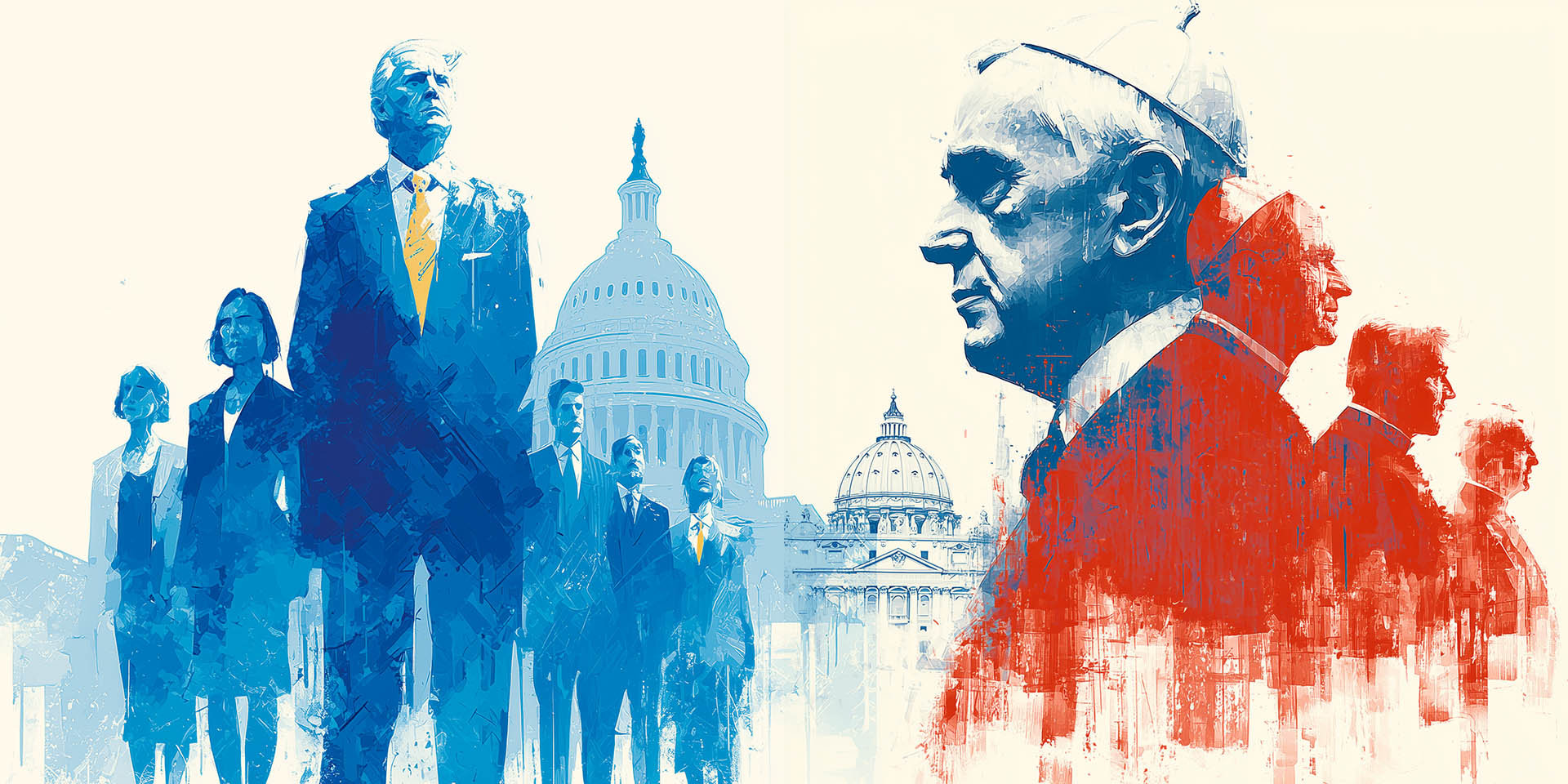
His Holiness Pope Francis has encouraged Catholics in the United States to participate in government, encouraging them in 2024 to vote for “the lesser evil.”1 However, some voters, Catholic or not, have lost faith in the election system that ultimately depends on electors to determine who will lead the United States for the next four years.2 Back in Rome, Pope Francis received his appointment in much the same way: a select group of electors, known as Cardinals, chose him as Bishop of Rome in 2013.3 The Electoral College has been a hot topic in the United States in recent years, particularly considering Donald Trump’s controversial election in 2016. As this article is being written during the height of the 2024 election season, Americans once again find themselves asking: what is the electoral college, and does it really work?
The Electoral College and the Sacred College of Cardinals are both, in a sense, republican. Each is an example of an indirect democracy in which a group of individuals represent the entire population and vote to elect a leader on the public’s behalf.4 These two institutions function similarly, and each has its own critics.5
The Electoral College emerged during the Constitutional Convention as a compromise between direct and congressional elections of the President.6 Outlined in Article II and the Twelfth Amendment of the United States Constitution,7 this system has long been controversial, with critics calling for its abolition, particularly due to concerns it undermines the principle of one person, one-vote.8 They argue the winner-takes-all approach adopted by most states distorts the individual voting power, leaving many citizens feeling disenfranchised.9
Catholics around the world have been calling for reform to the papal election process. In 1059, Pope Nicholas II published a papal bull that reformed the election process by assigning the task of electing the Pope to the Cardinals.10 In 1268, the death of Pope Clement IV marked the beginning of an election process that lasted nearly three years and ended only after the cardinals were sequestered in their palace and its roof was removed.11 After this election finally produced Pope Gregory X in 1271, the new Pope sought to further reform the process and avoid such inefficiency in the future. In 1274, at the Second Council of Lyons, he established the conclave as the means of electing future Popes.12 Pope Boniface VIII incorporated the process into canon law in 1298, and it has remained the standard procedure for papal elections since.13
While some voters and lay faithful may well understand the electoral processes, many are blind to the mechanics by which the votes are cast. In the United States, a presidential election takes place every four years.14 The process is lengthy, with candidates typically registering around eighteen months before election day.15 Candidates must be natural-born citizens of the United States, be at least thirty-five years old, and have been a resident of the United States for at least fourteen years to register.16 Electors have fewer requirements: they cannot hold certain offices like Senator or Representative, and must not have engaged in insurrection against the United States.17 Political parties in each state select electors, often choosing officials or party loyalists.18 When citizens vote for a candidate in the general election, they are actually voting for that candidate’s electors.19
These electors vote on the first Monday after the second Wednesday in December.20 States vary on how each elector votes.21 In Maine and Nebraska, the electors are assigned proportionally to the popular vote,22 while other states award all electoral votes to the popular vote winner.23 To win the presidency, a candidate must receive 270 electoral votes.24 If no candidate receives the required votes, the vote goes to the House of Representatives.25
Elections in Rome are far less frequent, with a new pope being elected only when the prior pope dies or resigns.26 Unlike many political elections, papal candidates need not declare an intent to run.27 In fact, any baptized Roman Catholic man can be elected as pope, and a layman who is elected would be immediately ordained as bishop.28 The Cardinals are selected by the Pope and serve lifelong appointments, though only those under eighty can vote for a new pope.29 While the laity do not elect Cardinals, papal appointments may reflect broader cultural trends and the Pope’s vision for the Church’s future.
Voting Cardinals gather in Rome shortly after the death or resignation of the Pope.30 They gather in the Sistine Chapel and take an oath of secrecy.31 They vote by secret handwritten ballots, which are then counted out loud.32 Two-thirds of the votes are needed to elect a pope.33 If no man receives this amount, the process repeats, four times per day until an election is made.34 When a successful election is made and the elected accepts his election, the ballots are burned in a stove with a mixture of chemicals, which produce the white smoke that signals to the world that a new pope has been elected.35 The election process is repeated as many times as necessary, with the longest being the nearly three-year election of Pope Gregory X.36
In Rome, a papal election typically follows the Pope’s death. But with Benedict XVI’s 2013 resignation, and concerns about Pope Francis’s health, just as Americans watch the news on Election Night to see the states turn red or blue, Catholics around the world may soon be focused on the Sistine Chapel, watching for black or white smoke.
These power transfers significantly affect American Catholics as they are the intersection of law and religion. The President can sign legislation, veto bills, and nominate federal officials. Similarly, the Pope can advocate for the Church’s position on important issues, publish guidance to worldwide Church leaders, and appoint bishops and cardinals. While Americans participate directly by voting in the election of the President, Catholic laity can indirectly influence papal selection by voicing concerns to priests and bishops and praying for the electing cardinals. Understanding the form and function of each of these election processes allows individuals to participate in the election processes to the highest extent, making informed decisions while appreciating their impact.
References:
1 Press Conference During the Return Flight from Singapore, The Holy See (Sept. 13, 2024), https://www.vatican.va/content/francesco/en/speeches/2024/september/documents/20240913-singapore-voloritorno.html.
2 Jocelyn Kiley, Majority of Americans Continue to Favor Moving Away from Electoral College, Pew Research Center (Sep. 25, 2024), https://www.pewresearch.org/short-reads/2024/09/25/majority-of-americans-continue-to-favor-moving-away-from-electoral-college/.
3 Biography of the Holy Father Francis, The Holy See, https://www.vatican.va/content/francesco/en/biography/documents/papa-francesco-biografia-bergoglio.html.
4 Electoral College, USA.Gov, https://www.usa.gov/electoral-college#:~:text=In%2048%20states%20and%20Washington,to%20win%20the%20presidential%20election (last updated Jan. 13, 2025); How Is a New Pope Chosen?, United States Conference of Catholic Bishops, https://www.usccb.org/offices/general-secretariat/how-new-pope-chosen#:~:text=The%20cardinals%20vote%20by%20secret,two%2Dthirds%20of%20the%20vote; 1983 Code c.349.
5 See supra note 2; Thomas Reese, Pope Francis Needs to Reform Papal Election Process – Carefully, National Catholic Reporter (Mar. 11, 2024), https://www.ncronline.org/opinion/guest-voices/pope-francis-needs-reform-papal-election-process-carefully#:~:text=Before%20he%20retires%20or%20dies,pope%20is%20not%20divinely%20inspired.
6 Electoral College History, National Archives, https://www.archives.gov/electoral-college/history#:~:text=The%20Founding%20Fathers%20established%20the,not%20appear%20in%20the%20Constitution.(Jun. 26, 2024).
7 U.S. Const. amend. XII.
8 Thomas Tai, One Person, One Vote: How Does the Electoral College Work?, League of Women Voters (Feb. 15, 2024), https://www.lwv.org/blog/one-person-one-vote-how-does-electoral-college-work.
9 Id.
10 Pope Nicholas II, Papal Bull In nomine Domini (Apr. 1059).
11 Understanding the Role of the Conclave and the Papal Election Process, LaCroix Int’l (Oct. 12, 2024), https://international.la-croix.com/religion/understanding-the-role-of-the-conclave-and-the-papal-election-process.
12 Second Council of Lyons, Constitution on Election and the Power of the Elected Person, The Holy See, (1274).
13 1983 Code c.349
14 Overview of the Presidential Election Process, USA.Gov (last updated Feb. 25, 2025), https://www.usa.gov/presidential-election-process.
15 Id.