St. Raymond of Penyafort, Pope Gregory IX, and the Living Tradition of Canon Law at Ave Maria School of Law
On the feast day of St. Raymond of Penyafort, patron saint of canon lawyers and one of the Church’s great jurists, Ave Maria School of Law reflects on a legal tradition that is not merely historical, but living.

St. Raymond of Penyafort
St. Raymond is most closely associated with one of the most consequential legal undertakings of the Middle Ages: the compilation of the Decretals of Pope Gregory IX, also known as the Liber Extra. This work did not invent new law. It ordered existing law, clarified its meaning, and rendered it intelligible, ensuring that justice could be administered with consistency, reason and moral purpose.
Pope Gregory IX and the Ordering of the Law
Raymond’s work cannot be understood apart from his collaboration with Pope Gregory IX, who recognized that canon law had grown increasingly unwieldy in the century following Gratian’s Decretum. Papal decretals issued in response to new legal and pastoral questions were authoritative, but scattered across multiple collections, sometimes overlapping and sometimes contradictory.
In 1230, Gregory summoned Raymond to Rome to serve as papal chaplain and adviser in matters of conscience and law. He entrusted Raymond with the task of examining, selecting and organizing the papal decretals issued since Gratian into a single, authoritative compilation.
This was not a mechanical exercise. Raymond resolved ambiguities, eliminated contradictions and arranged the law coherently. His work was formally promulgated in 1234 and became the foundational text of canon law for centuries.
Together, Gregory IX and Raymond offer a model of fides et ratio in action: authority exercised through reasoned law, and legal reasoning guided by moral truth.
Fides et Ratio in the Text Itself
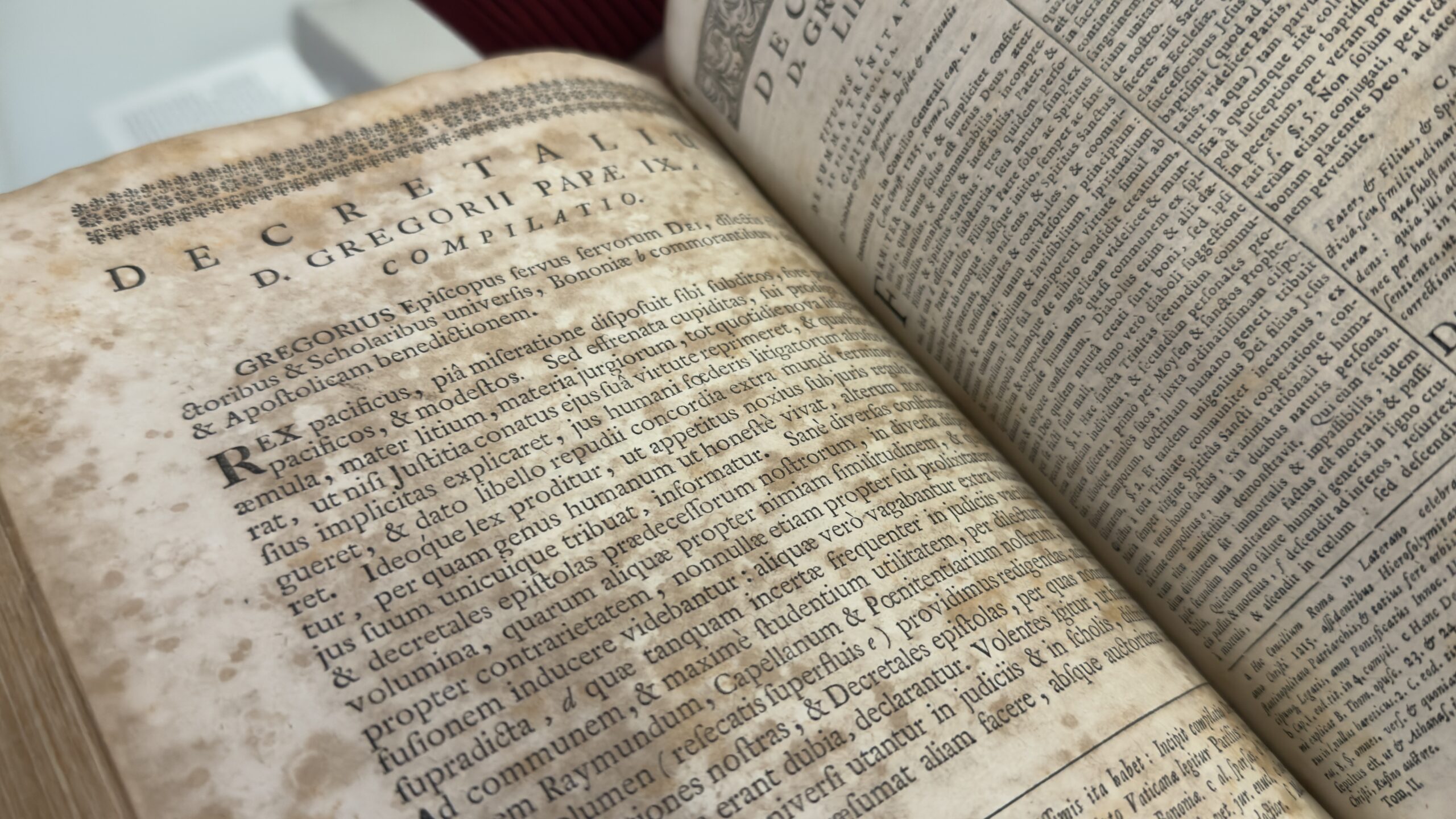
The purpose of law in this tradition is stated most clearly not in later summaries, but in the law itself. In the proemium to the Decretals of Pope Gregory IX, traditionally titled Rex pacificus, the rationale for law is set forth with striking clarity.
From the very page preserved in the Corpus Juris Canonici held at Ave Maria School of Law, we read:

“Ideoque lex prodidit, ut appetitus noxius sub juris regula limiteretur, per quam genus humanum ut honeste vivat, alterum non laedat, jus suum unicuique tribuat.”
A faithful English rendering reads:
“Therefore law was brought forth, so that harmful desires might be restrained under the rule of justice, by which the human person may live honorably, harm no one and render to each what is due.”
Here, faith and reason are not opposed. Law restrains disorder through rational rule, ordered toward justice and peace. Moral truth does not stand outside the law; it animates the law from within.
A Rare and Living Library on Campus
This tradition is not confined to history books. It is physically present on the campus of Ave Maria School of Law.
The Law Library houses a remarkable collection of rare canon law volumes generously gifted from the personal collection of Cardinal Edward Egan, former archbishop of New York. These works comprise one of the finest collections of early canon law materials in the region and are displayed in the library’s rare book cases.
Among them is a 1730 Cologne edition of the Corpus Juris Canonici, which contains in its second part the Decretals of Pope Gregory IX. The collection also includes an especially rare 1519 printing of Gratian’s Decretum and important early works by jurists such as Ernricus Pirhing and Anacletus Reiffenstuel. Many of the bindings remain original, bearing witness to centuries of careful preservation.
These volumes are not decorative artifacts. They are witnesses to a tradition that has always taken legal reasoning seriously because it takes truth seriously.
Conscience, Law and Moral Courage
St. Raymond’s own life reflects the principles he helped codify. He is often depicted at the edge of land and sea, an image rooted in a well-known episode from his life.
While serving as confessor to James I of Aragon, Raymond refused to remain at court when the king persisted in grave moral wrongdoing. When ships were forbidden to sail in order to prevent his departure, Raymond chose obedience to divine law over royal command. According to Dominican tradition, he placed his cloak upon the sea and crossed from Mallorca to Barcelona in a single day.
Artists depict him on a rocky shore or near a cave to mark the moment when conscience must act. In artistic depictions, the cave signifies withdrawal from corruption. The sea represents uncertainty and risk. The miracle that follows is not the point. The choice that precedes it is.
For lawyers, the image endures as a reminder that fidelity to truth sometimes requires standing apart before standing firm.
A Tradition We Study and Uphold
On the feast of St. Raymond of Penyafort, Ave Maria School of Law gives thanks for a living legal tradition rooted in faith, ordered by reason and preserved through careful stewardship. The rare books housed in the Law Library are more than historical treasures. They are part of the school’s intellectual and moral formation, reminding students that law is never merely procedural, but always ordered toward justice and the dignity of the human person.
Rooted in the Catholic intellectual tradition, Ave Maria School of Law forms lawyers to pursue justice with moral clarity, intellectual rigor and fidelity to truth. In the work of St. Raymond, the vision of Pope Gregory IX and the texts preserved on campus today, that tradition continues to speak.
***
The Decretals of Pope Gregory IX were promulgated in 1234 and compiled by St. Raymond of Penyafort at the direction of the pope. The quotation above is taken from the proemium (“Rex pacificus“) of the Liber Extra, preserved in the 1730 Cologne edition of the Corpus Juris Canonici held in the Cardinal Egan Collection at Ave Maria School of Law.