From Ave Maria Law to the U.S. Immigration Court
Alumna Nancy Nevarez-Myrick, J.D. ’16, reflects on her path to judicial service, her formation at Ave Maria School of Law, and the responsibilities of serving as an Immigration Judge
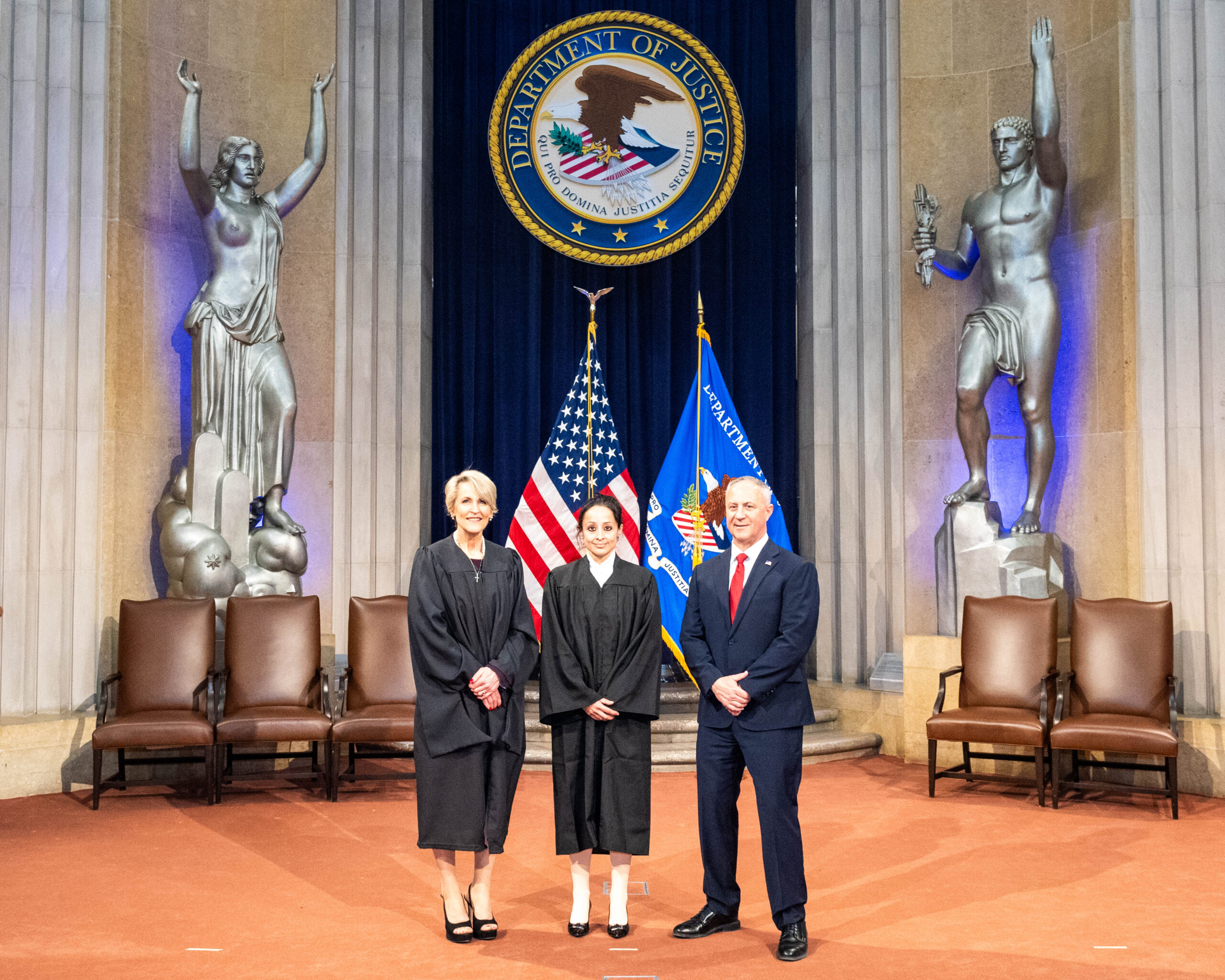
Ave Maria School of Law is proud to recognize alumna Nancy Nevarez-Myrick, J.D. ’16, on her appointment as an Immigration Judge with the U.S. Department of Justice’s Executive Office for Immigration Review.
Her path to the bench reflects a commitment to public service shaped by rigorous legal training, disciplined reasoning, and a deep respect for the rule of law. Formed at Ave Maria School of Law and refined through federal and military service, her career reflects the integration of principle and practice that defines the legal profession at its best.
In the following Q&A, Judge Nevarez-Myrick reflects on her formation, her professional journey, and the responsibilities of serving in the Immigration Court.
Ave Maria School of Law and Your Formation
How did Ave Maria School of Law help you prepare for your legal career and ultimately judicial service?
Ave Maria Law provided a full and well-rounded legal education that introduced me to black letter law, statutory construction principles, analytical legal frameworks, and federal and administrative law principles that were helpful in my career development.
Are there any professors, mentors, or courses that had a particularly strong influence on your formation as a lawyer?
Because of the types of law I have practiced to date—federal and military—courses including Military, Administrative, and National Security Law taught by Professor Kevin Govern; Federal Constitutional Law taught by Professor Timothy Tracey; Evidence taught by Professor Patrick Gillen; and Criminal Procedure taught by Professor Eugene Milhizer had a strong influence in my formation as a lawyer.
Courses such as Property, taught by Professor Kirk Miller; Civil Procedure, taught by Professor Richard Myers; and Torts, taught by Professor Mollie Murphy were also helpful in that they provided not only an understanding of the law in those areas, but also an opportunity to practice analysis and application of the law to the facts, which is important in what I do.
Your Path After Law School
Can you briefly describe your professional path following graduation from Ave Law and how each stage helped prepare you for your current role?
Soon after graduation in May 2016, I began studying for the Bar Exam, which I passed in September 2016. I was also an Associate Attorney for a brief time in a private law firm, conducting discovery and document review for a whistleblower case.
In August 2017, I graduated with an LL.M. in taxation and began my career as an Air Force Judge Advocate and Special Assistant to the U.S. Attorney’s Office in Georgia and then Colorado until 2021. I then became an Attorney-Advisor for the Department of Veterans Affairs. In February 2026, I was appointed by the U.S. Attorney General as a Temporary Immigration Judge.
Was there a moment when you first felt called toward public service or immigration law in particular?
I always felt that public service was my calling. There is always a need for public servants, especially those who have a desire to use their skills to provide quality service to the public and help in the efficient administration of government functions. My interest in immigration law arose after externing with the Department of Homeland Security during my time at Ave Maria.
Your New Appointment
What does your appointment as a Temporary Immigration Judge mean to you personally and professionally?
It is an enormous achievement filled with challenges and responsibilities that I look forward to. It is also an opportunity to refine my adjudicatory and analytical skills and gain a better understanding of our nation’s immigration laws and apply them as passed by our nation’s law-making body.
How do you hope to serve the public in this new role?
I look forward to helping the Immigration Courts in their function of processing cases effectively, efficiently, impartially, and fairly, by applying the immigration laws as passed by Congress.
What do you see as the responsibility of an immigration judge in a system where the legal issues are complex and the human stakes are so profound?
The role of the immigration judge is to fairly and impartially hear the cases before him or her and apply the laws without any bias or personal convictions, as passed by Congress. While there may be empathetic situations in these types of cases, the immigration judge always applies the law.
Advice for Ave Law Students
What advice would you offer to current Ave Maria School of Law students who are discerning a vocation in public service or the federal judiciary?
I would encourage Ave Maria School of Law students to intern or extern in government agencies to gain practical experience in these environments. Not every law student is meant for public service. However, a well-rounded experience in both private and public sectors only makes a legal professional better. While I have worked in the private sector and found that it was not for me, I still learned skills that became part of my toolbox and that I have used thereafter.
Looking back, what guidance would you give your own 1L self?
When I was in my first year of law school, I always thought that prosecuting, whether at the state or federal level, was my destined career. This type of mindset narrowed my course choices after my 1L year. As I developed as a legal professional, I learned that I should not shy away from learning and practicing in different legal fields.
Ave Maria School of Law congratulates Judge Nevarez-Myrick on this significant achievement and is proud to count her among its alumni serving the nation in public service.
Watch live: Cardinal Stefan Wyszyński University YouTube Channel
View the full conference agenda: Download the program (PDF)