Can Lawyers Become Saints?
Lessons from St. Thomas More and the Catholic Legal Tradition
Each year on June 22, the Church celebrates the feast of St. Thomas More, the patron saint of lawyers, judges, statesmen, and public officials. More’s life continues to inspire Catholics who seek to serve both God and society with integrity, courage, and fidelity to conscience.
This year, the June issue of Magnificat features an article titled “Saints Who Studied Law,” highlighting several saints whose legal training became a means of serving both the Church and society. Together, these examples remind us that the study of law is not merely preparation for a career. For Catholics, it can also be preparation for a vocation.
At first glance, law and holiness may seem to belong to different worlds.
One concerns statutes, contracts, courts, and disputes. The other concerns prayer, virtue, sacrifice, and union with God.
Yet the history of the Church tells a different story.
Some of the Church’s most remarkable saints studied law, practiced law, advised rulers, shaped legal systems, and wrestled with questions of justice that affected entire nations. They understood that the law is not merely a profession. Properly understood, it is a service to truth and to the common good.
The Church does not ask whether a person is called to be a lawyer or a saint. The Church asks whether a lawyer can become a saint.
History has already answered that question.
St. Thomas More remains one of history’s most enduring examples of legal integrity. A renowned lawyer, scholar, and statesman, More served as Lord Chancellor of England under King Henry VIII. When pressured to endorse actions that violated his conscience, More chose fidelity to God over political power, ultimately giving his life rather than betray what he believed to be true.
For that reason, St. Thomas More remains the patron saint of lawyers, judges, statesmen, and public officials. His witness reminds us that justice requires more than legal knowledge. It requires courage.
More was not alone.
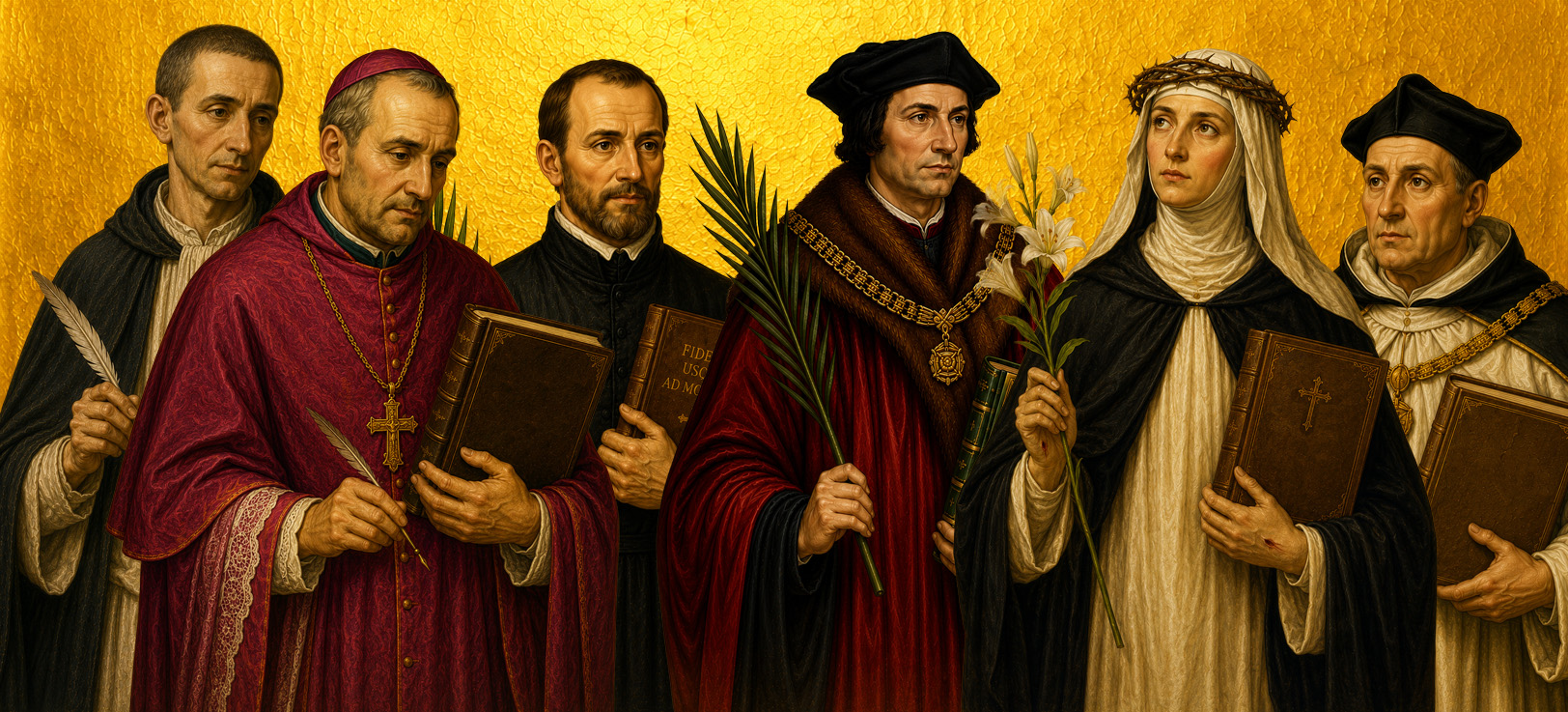
The Church’s saints reveal different dimensions of the legal vocation. Blessed John Storey, a lawyer, judge, and member of Parliament, demonstrated fidelity to truth under political pressure during the English Reformation. St. Raymond of Penyafort, one of the great canon lawyers of the Middle Ages, reminds us that law must be tempered by mercy. St. Alphonsus Liguori highlights the importance of a well-formed conscience. St. Ivo of Kermartin, the patron saint of lawyers, exemplifies a commitment to justice for rich and poor alike. And St. Catherine of Siena, though not a lawyer, became one of the Church’s most influential voices in matters of governance, reform, and moral leadership, reminding us that courage and wisdom are essential to the pursuit of justice.
Though separated by centuries and circumstances, these men and women shared a common conviction: law exists to serve the human person and to advance justice.
Father David Pignato understands the relationship between law and vocation from both personal and professional experience. A Harvard Law School graduate who practiced law before discerning a call to the priesthood, Father Pignato now teaches jurisprudence and constitutional law at Ave Maria School of Law, where he focuses on questions of religious liberty, Church-state relations, and the foundations of legal thought.
“Human law pursues and promotes truth when it achieves justice, but only if justice is defined and understood properly as what is owed to the human person as a result of our objective human nature,” Father Pignato said. “When the law recognizes the truth of our being as human persons, it pursues the truth.”
That understanding reflects a distinctly Catholic view of the law. Rather than seeing law merely as a system of rules or regulations, the Catholic tradition understands law as something rooted in truth, human dignity, and the common good.
Dean John Czarnetzky believes the example of St. Thomas More remains as relevant today as it was nearly five centuries ago.
“Thomas More’s witness remains relevant because every generation faces pressures to compromise conscience for convenience, advancement, or public approval,” Dean Czarnetzky said. “His example reminds lawyers that professional success is not the highest good. The law is ultimately ordered toward justice, and justice requires the courage to remain faithful to truth even when doing so is difficult or unpopular.”
Father Pignato also notes that the practice of law can become a path to holiness when lawyers place their talents at the service of others.
“The practice of law, like any work or profession, can lead to holiness because it presents an opportunity to make a gift of self,” he said. “When the practice of law is conducted to end injustice and to protect the true rights of others, it can lead to holiness by working to build up the Kingdom of God here on earth.”
Father Pignato’s own journey from the practice of law to the priesthood illustrates that legal training can prepare individuals not only for a profession, but also for lives of service in a wide variety of vocations.
For Catholics, the examples of these saints challenge a common misconception. Holiness is not reserved for priests, religious sisters, or missionaries. It is the universal call of every Christian, including those who work in courtrooms, law offices, legislatures, classrooms, and public service.
In an age when law is often viewed primarily through the lens of politics, power, or personal advancement, the saints offer a different vision. They remind us that legal training can be directed toward something greater than professional success. It can become a means of serving truth, defending human dignity, protecting conscience, and pursuing justice.
The Church does not ask whether lawyers can become saints.
History has already answered that question.
The challenge for every generation is whether lawyers will choose to follow their example.
Did You Know? A Law Professor Is on the Path to Sainthood
While St. Thomas More may be the most famous lawyer-saint, one of the most remarkable legal figures in Catholic history is Blessed Contardo Ferrini (1859-1902).
An accomplished Italian legal scholar and professor of Roman law, Ferrini spent his career teaching, researching, and mentoring students at several universities. His doctoral research explored the history of criminal law through the writings of Homer and Hesiod, reflecting a lifelong belief that the study of law should be informed by history, literature, and a deeper understanding of the human person.
 Unlike many saints associated with the law, Ferrini did not become a priest, bishop, or religious. Instead, he pursued holiness while living the life of a lay academic.
Known for his intellectual brilliance, humility, devotion to the Eucharist, and service to the poor, Ferrini demonstrated that professional excellence and deep faith need not exist in separate spheres. His life embodied the harmony of faith and reason, showing that scholarly work itself can become a path to sanctity.
Reflecting on the purpose of life, Ferrini once wrote: “Our life must reach out towards the Infinite, and from that source we must draw whatever we can expect of merit and dignity.”
Beatified in 1947, Ferrini remains a powerful example for lawyers, professors, students, and professionals seeking to integrate their faith with their daily work. His legacy reminds us that holiness is not reserved for those who leave professional life behind. It can be found in the classroom, the library, the courtroom, and the quiet pursuit of truth.