Faith, Reason, and the Future of Democracy: Ave Maria Law at the 5th Biennial Conference on Religion and Politics
WARSAW, POLAND — November 6, 2025
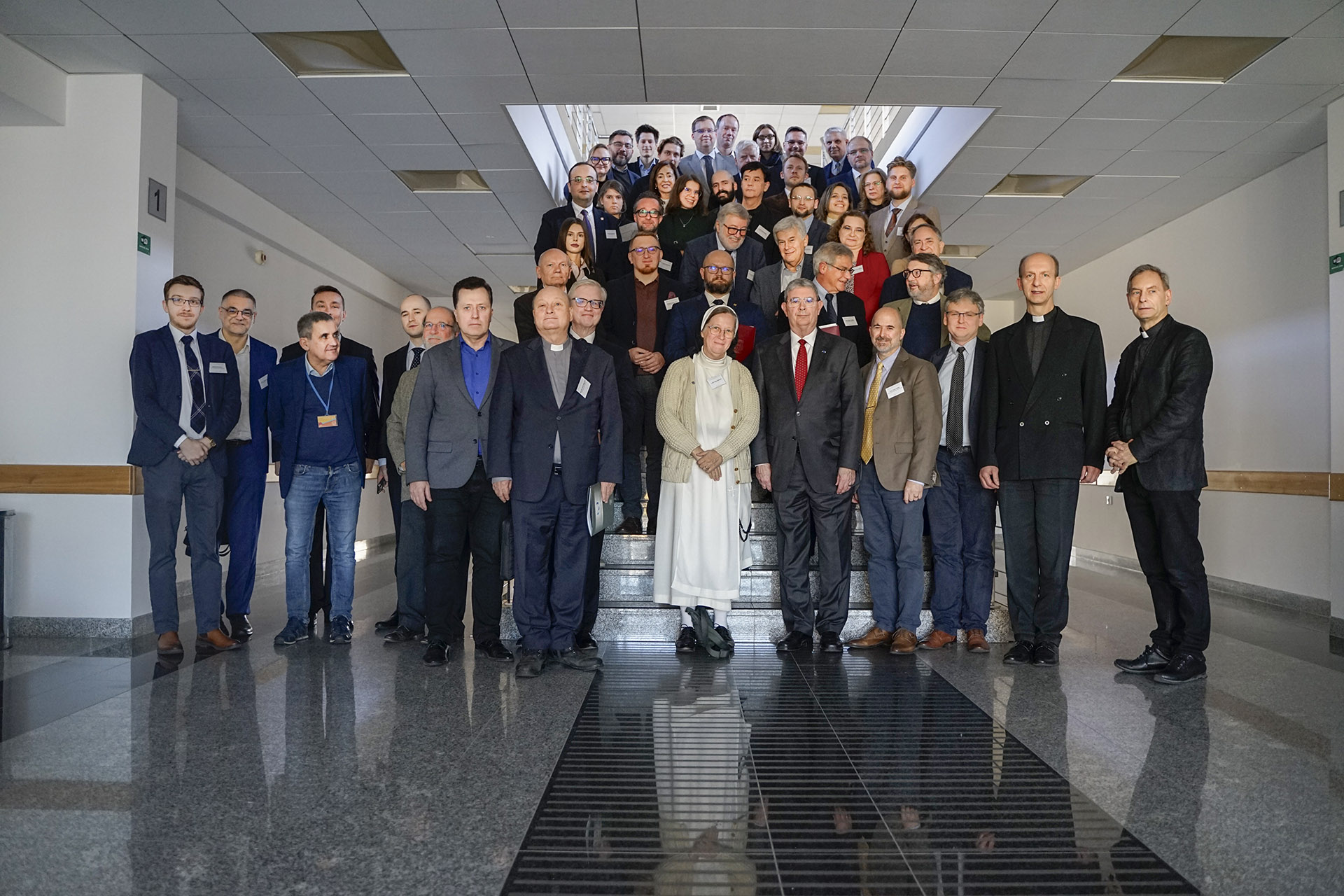
At the 5th Biennial Conference on Religion and Politics, hosted by the Institute of Political Science and Public Administration at Cardinal Stefan Wyszyński University, international scholars gathered to examine whether the teachings of St. John Paul II still speak to the modern world.
The two-day conference marked the 20th anniversary of the late pontiff’s death and reflected on the enduring relevance of his social and political thought. Ave Maria School of Law was represented by Dean John M. Czarnetzky, Professor Ligia Castaldi, and Professor Brian Scarnecchia.
 George Weigel Opens with a Call to Hope and Truth
Catholic theologian and papal biographer George Weigel, Distinguished Senior Fellow at the Ethics and Public Policy Center, delivered the opening keynote, “Does St. John Paul II Still Speak to Us Today?”
Weigel reflected on the moral and spiritual legacy of the sainted pope, warning against relativism and the “infantilization of freedom” in contemporary Western democracies. He called for a renewal of moral culture grounded in truth:
“The free society depends on a truth-based culture,” Weigel said. “If our politics are divisive and rancorous, it is almost certainly because something is wrong with our public moral culture.”
He drew on Fides et Ratio to emphasize the need for a civilization rooted in both faith and reason:
“As St. John Paul II said, Faith and reason are like two wings on which the human spirit rises to the contemplation of truth.”
Weigel urged the West to rediscover the intellectual and moral foundations of its own civilization—Jerusalem, Athens, and Rome—and to resist what Pope Benedict XVI once described as a “dictatorship of relativism.”
Dean Czarnetzky: The Human Hunger for Truth
 Following Weigel’s address, Dean John M. Czarnetzky offered commentary highlighting humanity’s intrinsic desire for truth and meaning:
“Human beings hunger for the truth,” he said. “We crave the truth. We are unsettled when we believe we are living outside of it.”
Czarnetzky recalled St. John Paul II’s 1995 homily in Baltimore, in which the pope proclaimed, “Jesus Christ is the answer to the question posed by every human life.”
“That single sentence changed the way I see the world,” Czarnetzky reflected. “Our lives each pose a question, and the search for that answer leads us directly to Christ, who is Truth itself.”
The Church as Expert on Humanity
Czarnetzky, who has served as an advisor to the Holy See’s Mission to the United Nations for more than two decades, also cited Pope Paul VI’s 1965 address to the UN, describing the Church’s role as “expert on humanity.”
“The Church is not present in public life to impose, but to propose—to share its expertise on the human person,” he said. “That public witness to truth is essential, especially in institutions that have grown increasingly secular.”
The Nature and Purpose of Law
Turning to his own discipline as a legal scholar, Dean Czarnetzky reflected on St. Thomas Aquinas’s classical definition of law—an idea later revived in Catholic social teaching and central to the Church’s understanding of justice and the common good.
“Law is an ordinance of reason for the common good, made by one who has care of the community, and promulgated,” he said. “Yet in most modern law schools, this foundational truth is rarely even discussed. When we forget the moral purpose of law, we risk severing it from truth altogether.”
A Broader Dialogue: Faith, Freedom, and History
Other panelists expanded on related themes from Weigel’s talk.
Prof. Robert Fastiggi of Sacred Heart Major Seminary emphasized the importance of a “truth-based culture” that acknowledges the Creator, warning against the “practical agnosticism” of Europe’s secular elites.
“When God is forgotten, the creature itself also grows unintelligible,” he said, quoting Gaudium et Spes.
Prof. Paweł Skibiński of the University of Warsaw underscored St. John Paul II’s conviction that freedom must be grounded in truth and oriented toward God:
“Relativism prevents the formation of any true human community, including the political one,” he said. “For John Paul II, patriotism is not contrary to universalism—it is the path to it.”
Hope in a Disordered Age
Closing the discussion, Weigel returned to the importance of hope in the face of modern political disillusionment:
“Optimism and pessimism are matters of optics,” he said. “Hope—one of the theological virtues—is the sturdier foundation. The tears of the twentieth century can still prepare the ground for a new springtime of the human spirit.”
Watch live: Cardinal Stefan Wyszyński University YouTube Channel
View the full conference agenda: Download the program (PDF)
Conference Continues
The 5th Biennial Conference on Religion and Politics: “Supreme Guarantee Against All Abuses of Power? Question of God and Existence of Politics” continues today and tomorrow at Cardinal Stefan Wyszyński University in Warsaw. Held in memory of St. John Paul II, the event brings together leading scholars from around the world to explore the moral and theological foundations of public life.
Ave Maria School of Law is represented among the distinguished participants, including:
-
Prof. Ligia Castaldi, presenting “Constitutional right to abortion in communist/ post-communist countries: an international comparative law perspective.”
-
Prof. Brian Scarnecchia, presenting “Human Enhancement Regulated by John Paul II’s Understanding of Human Ecology”
-
Dean John M. Czarnetzky, delivering the conference summary alongside Prof. Michał Gierycz, chair of the organizing committee