Ave Maria Law Professors Examine Moral Law and Culture Wars at Warsaw Conference
Warsaw, Poland — At the 5th Biennial Conference on Religion and Politics, hosted by the Institute of Political Science and Public Administration at Cardinal Stefan Wyszyński University, international scholars gathered to reflect on whether the teachings of St. John Paul II continue to speak to the moral and political challenges of the modern world.
The two-day conference marked the 20th anniversary of St. John Paul II’s death and explored the enduring relevance of his thought for questions of human dignity, freedom, and law. Ave Maria School of Law was represented by Dean John M. Czarnetzky, Professor Brian Scarnecchia, and Professor Ligia Castaldi.
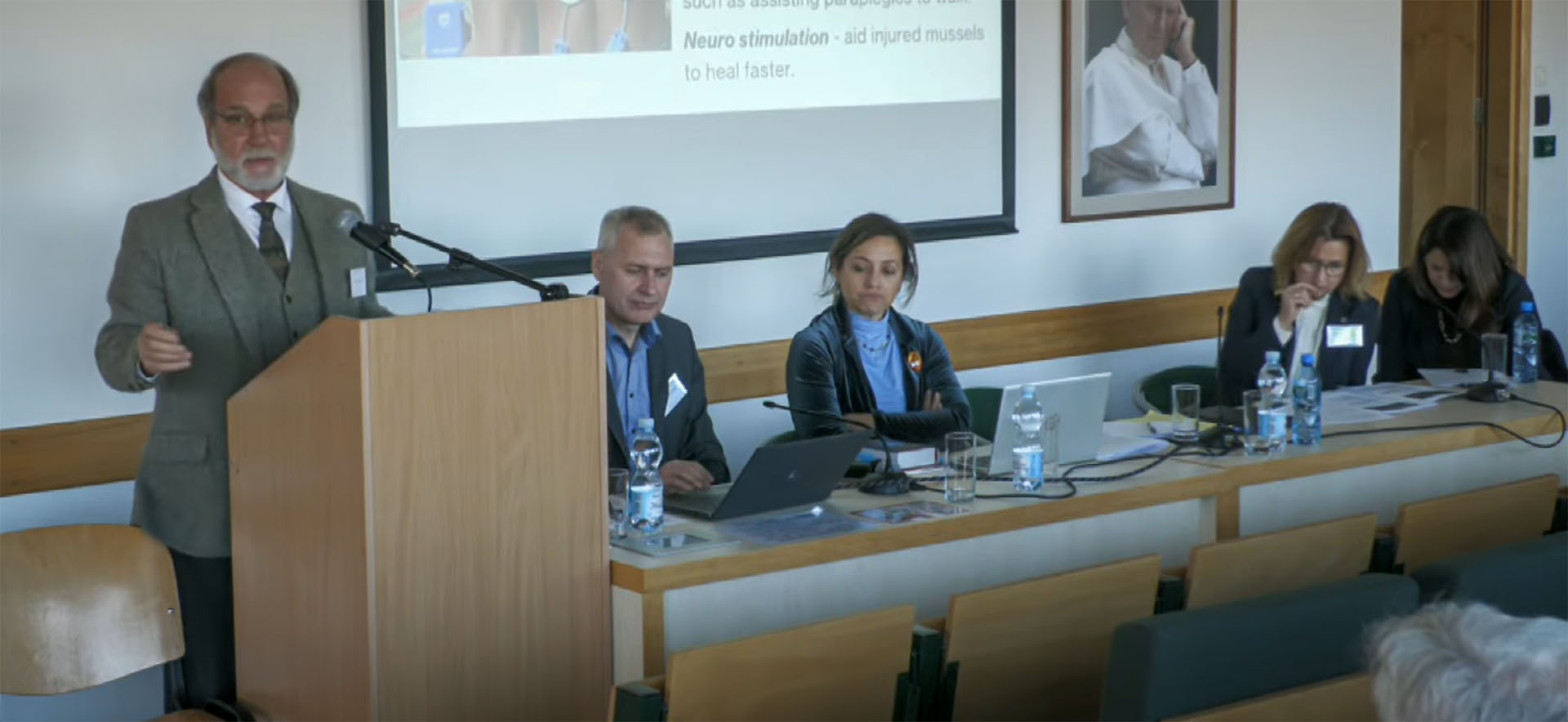
Panel 8: Moral Law and Culture Wars
Moderated by Professor Rafał Prostak, the panel brought together scholars from Poland, Italy, and the United States to discuss how moral law remains a source of conflict and renewal in contemporary culture.
Presentations ranged from philosophical critiques of European legal theory to examinations of artificial intelligence, human enhancement, and abortion law through the lens of Catholic social teaching.
Professor Brian Scarnecchia — “Human Enhancement Regulated by John Paul II’s Understanding of Human Ecology”
Professor Brian Scarnecchia addressed the ethical limits of biotechnology and transhumanism, applying St. John Paul II’s notion of human ecology to emerging questions of genetic engineering and human enhancement.
Opening with J. R. R. Tolkien’s familiar motif of the “locked door” in fairy tales—a symbol of the boundaries set by divine law—Scarnecchia warned against a modern temptation to cross moral and biological limits in the pursuit of power over human nature.
“The prohibition against eating of the tree of the knowledge of good and evil,” he said, “symbolically evokes the insurmountable limits that man, being a creature, must freely recognize and respect with trust.”
He categorized current forms of human enhancement—genetic, physical, cognitive—and distinguished between restorative therapies and augmentations that attempt to “exceed natural capacities.” Germline editing, he noted, poses special dangers because its effects are heritable and unpredictable, recalling the eugenic abuses of the past.
“The eugenics of today won’t be like the eugenics of yesterday,” Scarnecchia observed. “Today it will be voluntary—but voluntary with an awful coercive thrust to it.”
Turning to natural-law theory, he drew parallels between environmental and human ecology, proposing that the “precautionary principle” used in environmental law could guide bioethics: when potential harm to human nature is irreversible, the burden of proof should rest on those advocating intervention.
“Just as there are natural laws that flourish nature,” he concluded, “so there are natural laws that flourish human nature. A human ecology that respects the integrity of both body and soul is essential if law is to protect human dignity in the age of biotechnology.”
Professor Ligia Castaldi — “Constitutional right to abortion in communist/ post-communist countries: an international comparative law perspective.”
Following Professor Scarnecchia, Professor Ligia Castaldi presented a comparative legal analysis of abortion laws in communist and post-communist nations, tracing how different regimes have shaped legal conceptions of life and human rights.
“Constitutional rights have legal effects,” she explained. “They can imply a state duty to subsidize abortion or to provide abortions in public hospitals, so understanding where those rights exist — and where they do not — is essential.”
Castaldi’s research showed that no communist or post-communist constitution explicitly recognizes a right to abortion. Instead, many regimes tolerated abortion as a policy tool of population control or family planning, often accompanied by forced procedures in countries such as China and North Korea.
She contrasted these systems with nations like Poland, Hungary, and Slovakia, where constitutional courts and legislatures affirm pro-life protections.
“To me,” she said, “the notion of a constitutional or human right to abortion is a creation of the Western world—a cultural construct that never arose within communist or post-communist systems.”
Her data revealed that communist nations historically recorded the highest abortion rates in the world, while several post-communist societies, notably Russia and Poland, have since reversed course. Castaldi concluded that the Western portrayal of abortion as an emblem of freedom represents a departure from natural-law traditions that once underpinned European legal culture.
Shared Themes
Both Ave Maria Law professors rooted their scholarship in St. John Paul II’s teaching on the human person—affirming that authentic freedom depends on truth and that moral law must govern technological and political power.
Where Castaldi examined the cultural and legal aftermath of ideological systems that devalue life, Scarnecchia explored how new technologies risk repeating those same errors under the guise of progress. Together, their work embodied Ave Maria School of Law’s mission to unite faith, reason, and moral clarity in the study of law.
Watch live: Cardinal Stefan Wyszyński University YouTube Channel
View the full conference agenda: Download the program (PDF)
Conference Continues
The 5th Biennial Conference on Religion and Politics: “Supreme Guarantee Against All Abuses of Power? Question of God and Existence of Politics” continues today and tomorrow at Cardinal Stefan Wyszyński University in Warsaw. Held in memory of St. John Paul II, the event brings together leading scholars from around the world to explore the moral and theological foundations of public life.
Ave Maria School of Law is represented among the distinguished participants, including:
-
Prof. Ligia Castaldi, presenting “Constitutional Abortion Rights in the World and Judicial Activism”
-
Prof. Brian Scarnecchia, presenting “Human Enhancement Regulated by John Paul II’s Understanding of Human Ecology”
-
Dean John M. Czarnetzky, delivering the conference summary alongside Prof. Michał Gierycz, chair of the organizing committee